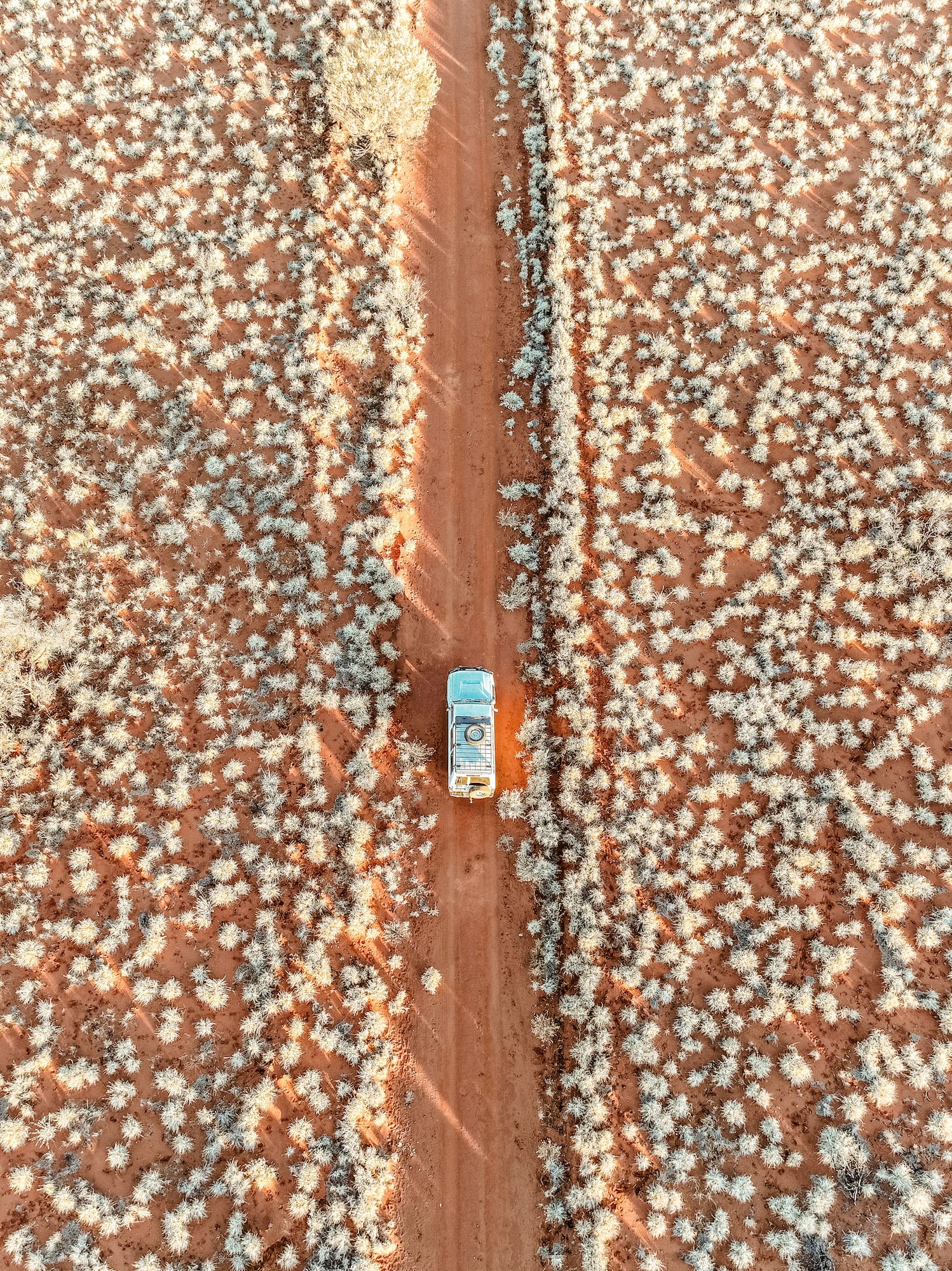
Galah travels to central Australia to meet the Tjanpi Desert Weavers, hundreds of artists who create contemporary fibre art of startling originality from native grasses.
Words Sam McCue
Photography Brooke Bathern
Inma Tjanpi (Song of the Grasses)
Rapiyanya parparmanu (Raffia shimmers)
Tjanpinya parparmanu (Grass shimmers)
Kutanunya parparmanu (Greybeard grasses shimmer)
Rapiyana tukulmara ngaringu (Raffia rustles)
Walka nganampa walkayuringu (Our designs take shape and colour)
Sign at Tjanpi Desert Weavers gallery, Mparntwe/Alice Springs
THE full moon’s rising and, on the other side of this vast red dune, the sun is setting in a final blaze of light. Kangaroo tails are back in the fire, scraped of burnt fur, showered with chicken salt and wrapped in aluminium foil. One woman takes charge of the shovel, nudging sweet potatoes deeper into the embers, making little puffs of ash and smoke. The other women, some in camp chairs, some cross-legged on mats, chat in Pitjantjatjara – instructions, laughter, memories, grumbles about the cold creeping in. Blankets are produced and the food is ready. These internationally renowned artists are right at home.
We’re five hours’ drive south-east of Mparntwe/Alice Springs, on Ngaanyatjarra Pitjantjatjara Yankunytjatjara (NPY) Lands. At 350,000 square kilometres, the NPY Lands are bigger than Italy, encompassing 26 remote communities and homelands in the central desert regions of South Australia, Western Australia and the Northern Territory.
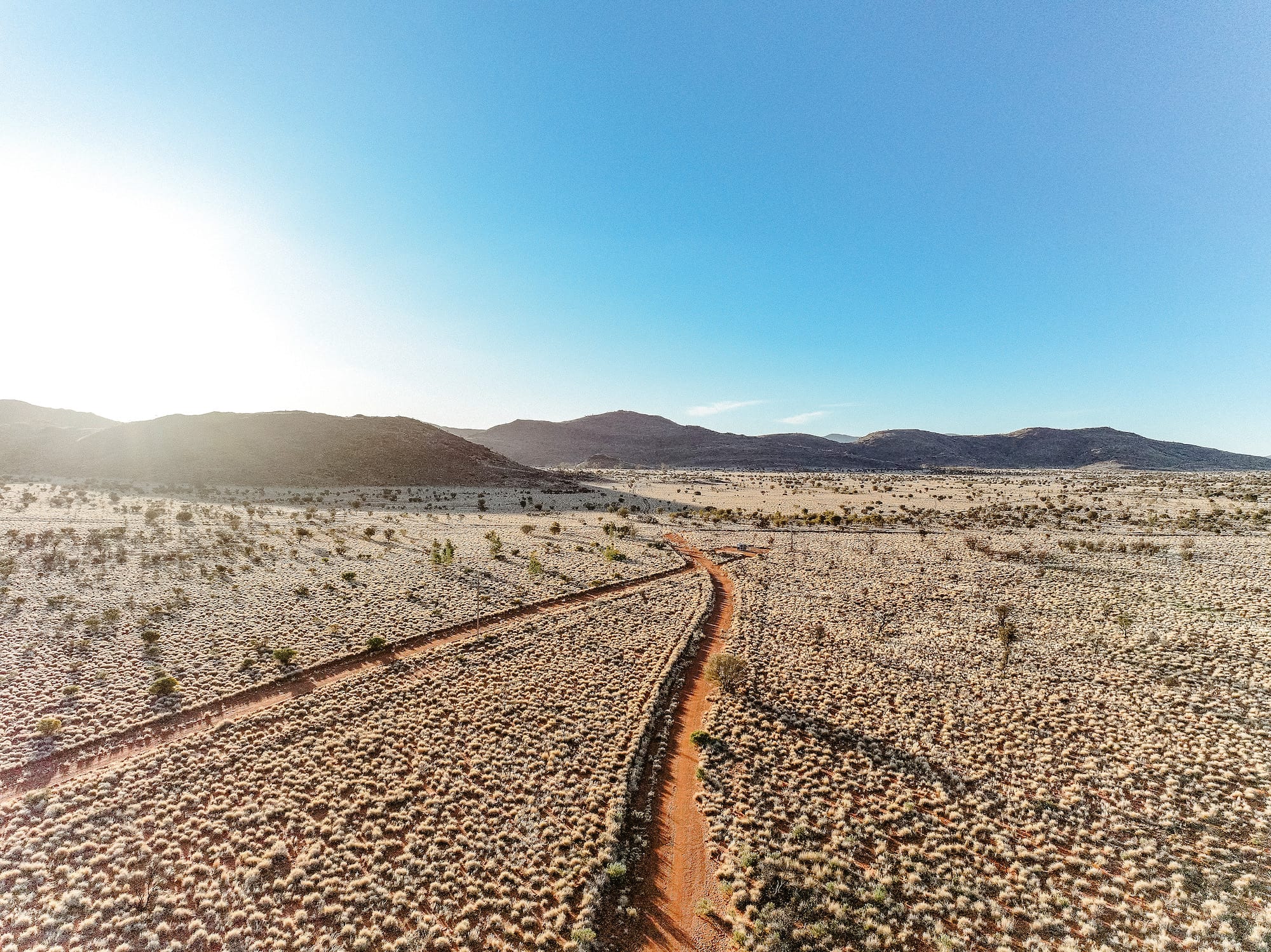
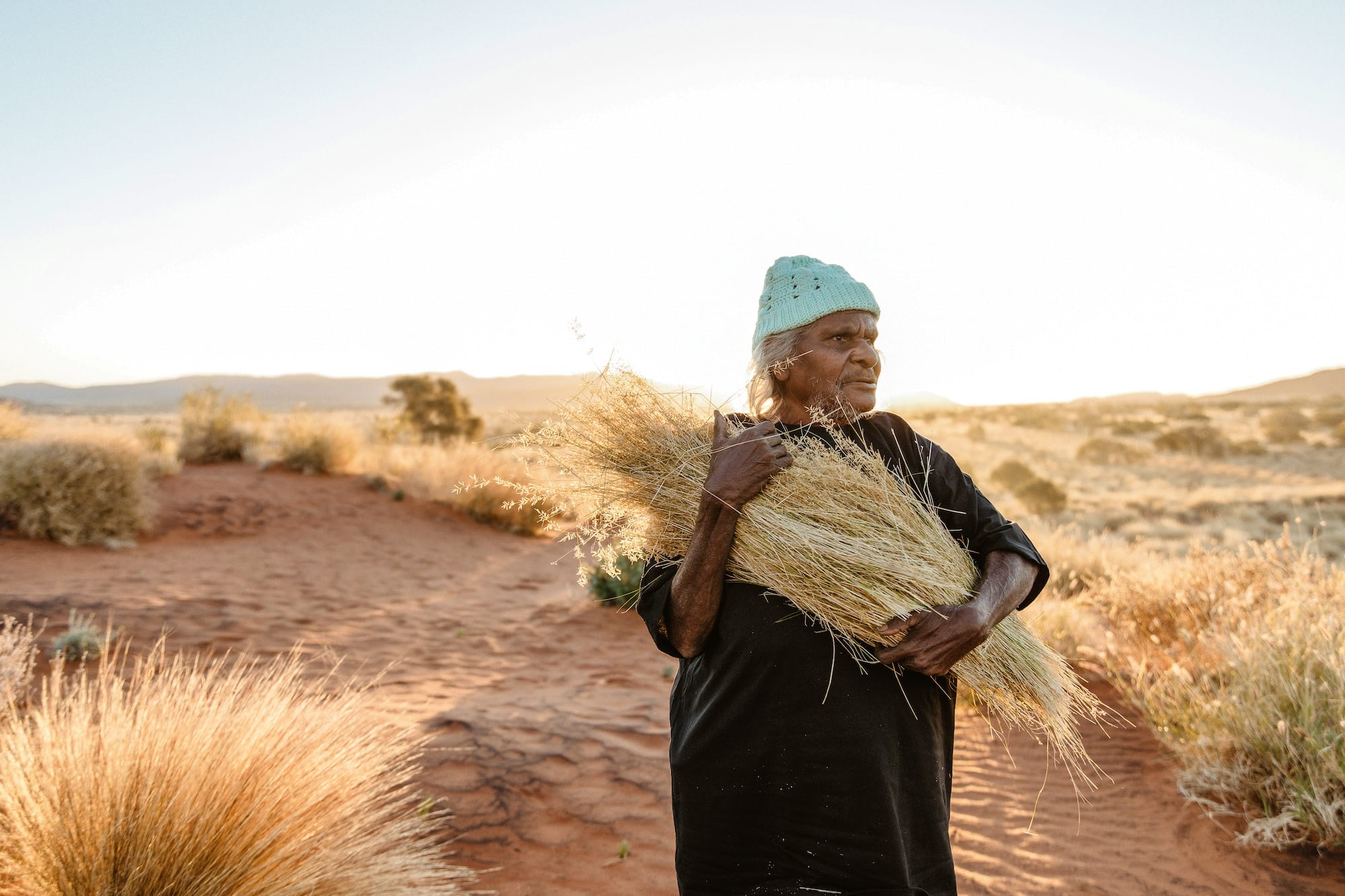
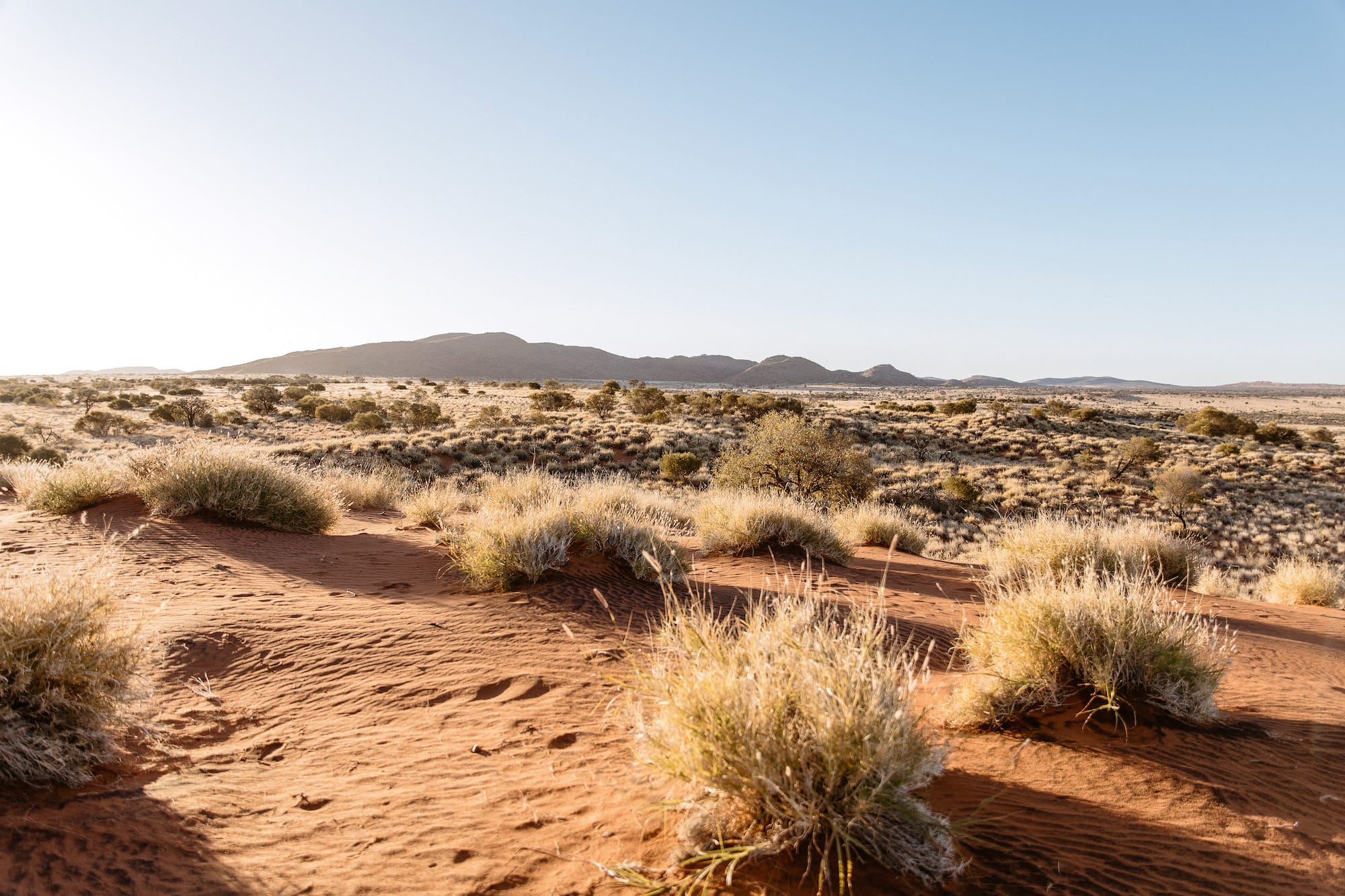
It’s a patchwork landscape of low ridges, rugged hillsides, rust-hued outcrops, sparse trees, dunes and plains strewn with pale blonde tussocks. Much of the grass is, sadly, invasive buffel grass. But, for those who know how to find them, good patches remain of the native grasses collectively known as tjanpi.
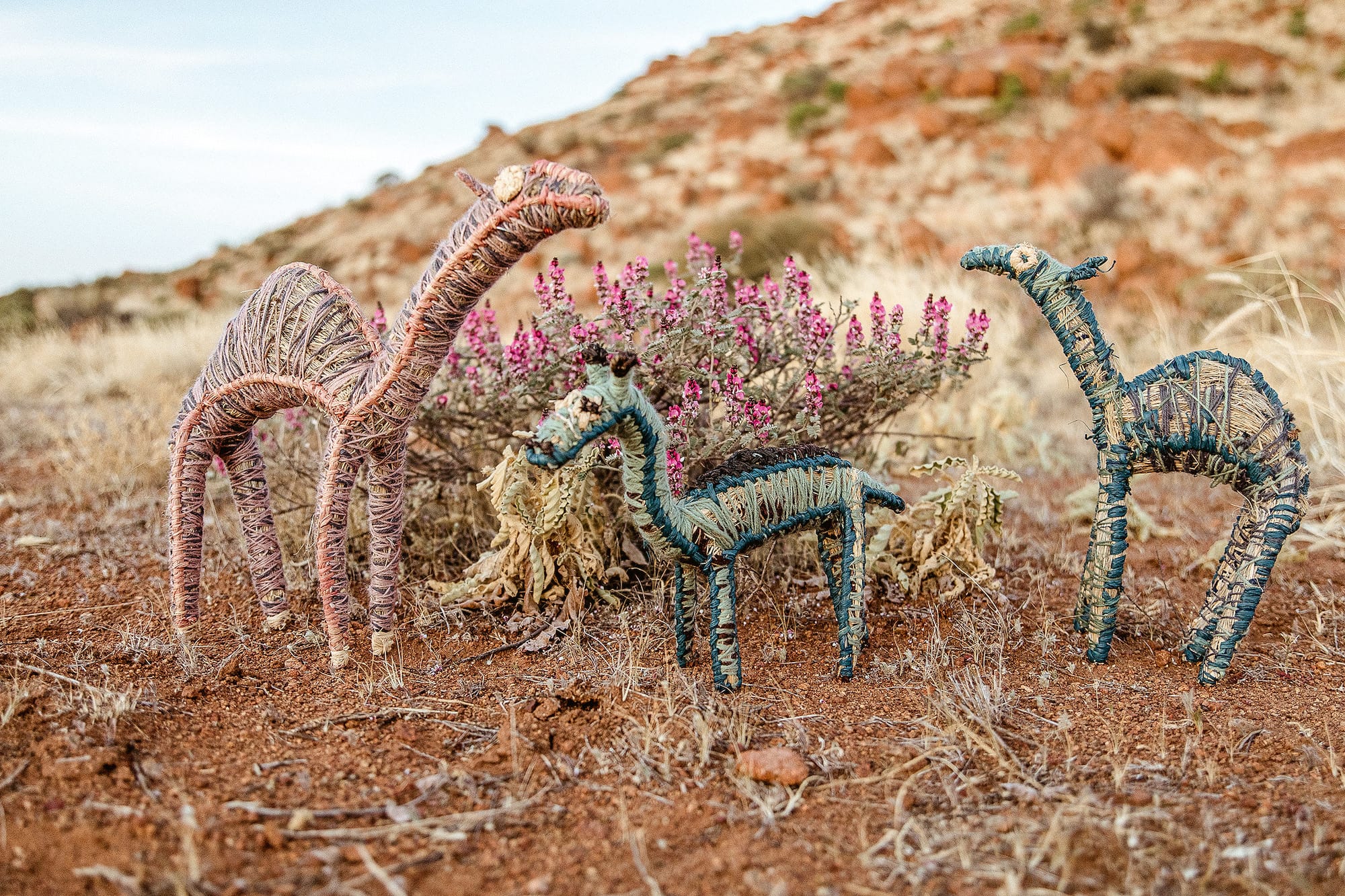
These grasses are the raw material used by the Tjanpi Desert Weavers, about 400 artists across the NPY Lands who create contemporary fibre art of startling originality – from intricately stitched baskets, to vibrant desert creatures, to huge pieces using car-seat frames as their foundations.
Started 30 years ago as a social enterprise under the NPY Women’s Council, Tjanpi Desert Weavers are now represented in private collections and institutions worldwide, including the Australian pavilion at the 2025 World Expo in Osaka and the Tate Modern art gallery shop in London.
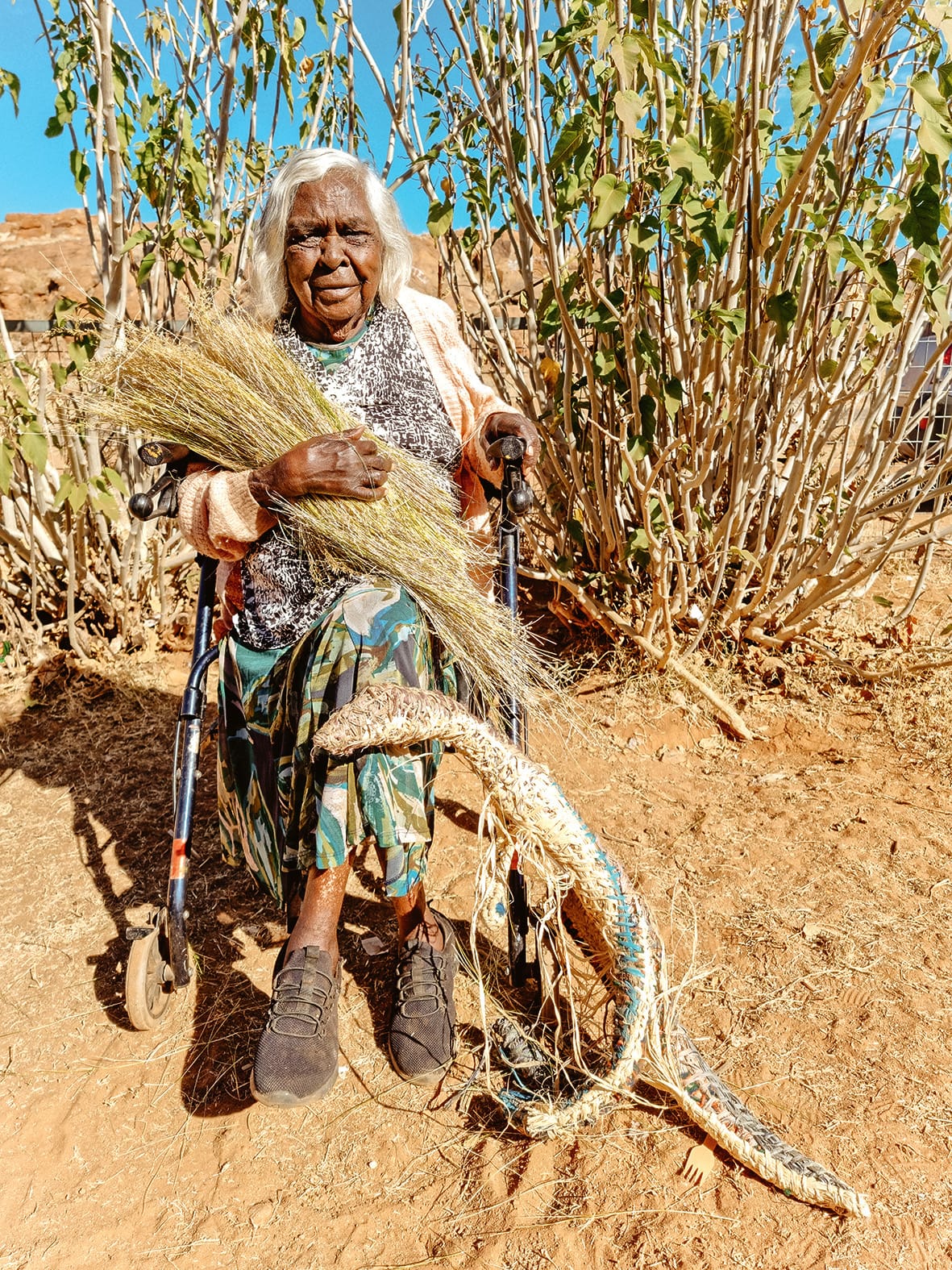
One of its most senior artists is Tjunkaya Tapaya. She was awarded an Order of Australia in 2020 in recognition of her work in art and education. She died soon after Galah published this story. She was in her late 70s, a celebrated multi-disciplinary artist who worked in batik, ceramics, painting, carving and sculpture – including a magnificent self-portrait, Ngayulu Minyma Tjanpinya, I am a Tjanpi Woman, a life-sized woman surrounded by animals, housed in the National Portrait Gallery.
“I make all sorts of different sculptures and baskets, beautiful things,” she told Galah, when a group of weavers gathered for afternoon tea in Umuwa, near her hometown of Pukatja/Ernabella. She’s speaking in Pitjantjatjara, later translated, but her passion for working with tjanpi and her admiration for her fellow artists require no interpretation.
“I make baskets, birds, animals, perentie lizards, kangaroos. I try to make everything beautiful and strong. I’m not alone. I’m one of hundreds of weavers who make lovely things. We like to work in our homes and we are proud of the quality of our work. We weavers make our sculptures at home and then
we sell them.”
As Tapaya talks, another artist, Anne Jack, writes me a list: malu – kangaroo, ngintaka – perentie, piti – basket.
“We women make different sculptures, like kangaroos, and also Tjukurpa stories [the creation stories central to Anangu culture] such as women in the Tjukurpa times, like the Seven Sisters,” continues Tapaya.
“This means we would make seven large sculptures of women, some quite realistic. Seven women from the creation times. Some of our groups of seven women are in major exhibitions in Canberra and Sydney and places like that.”
There’s a final point that Tapaya would like to make. “Thank you for coming by and saying hello. I’d like to say how impressed I am by all the Tjanpi Desert Weavers all over the Lands. Women have learned so much over the years and become really skilled and creative with tjanpi work. It’s great to see.”
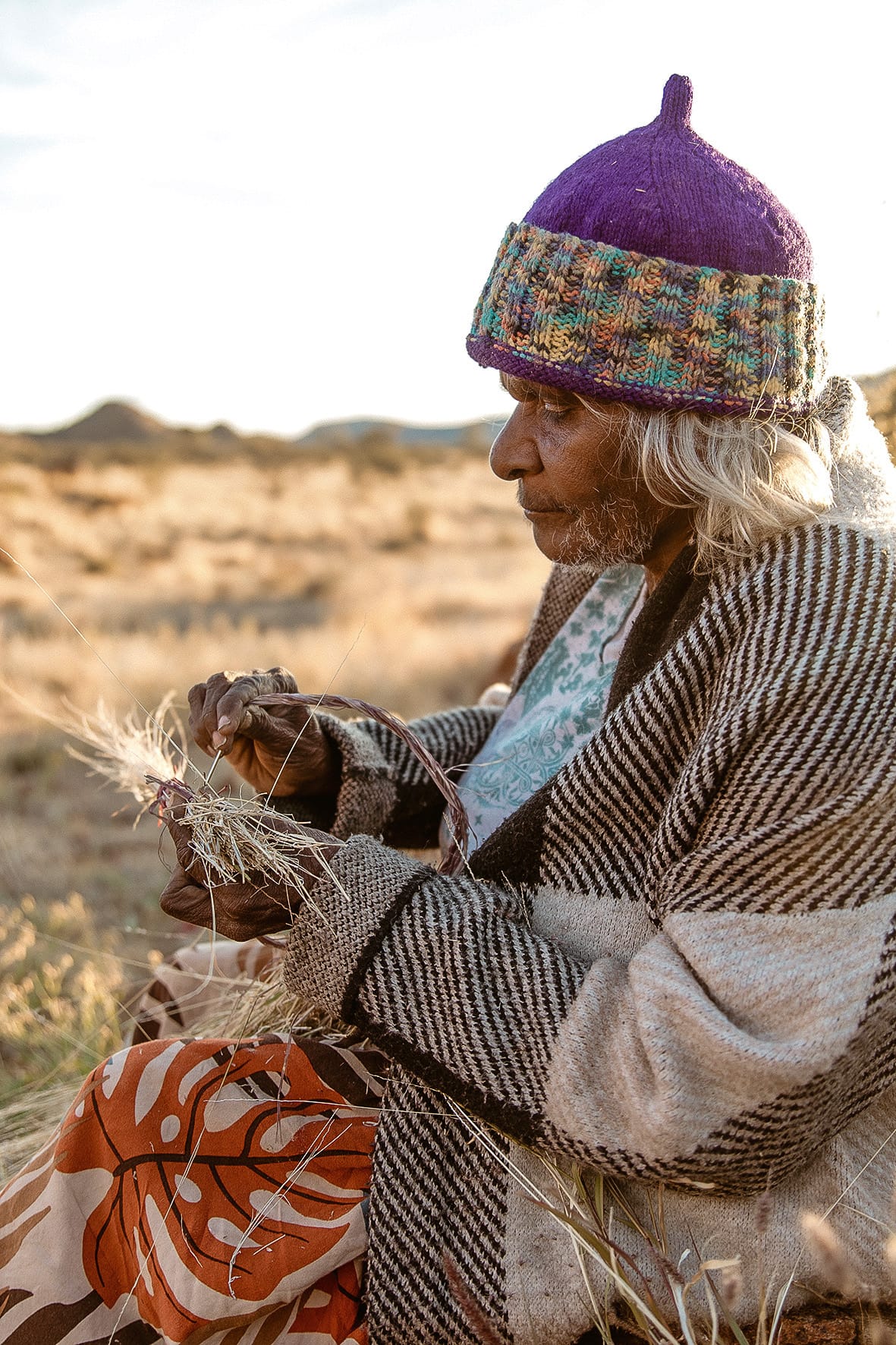
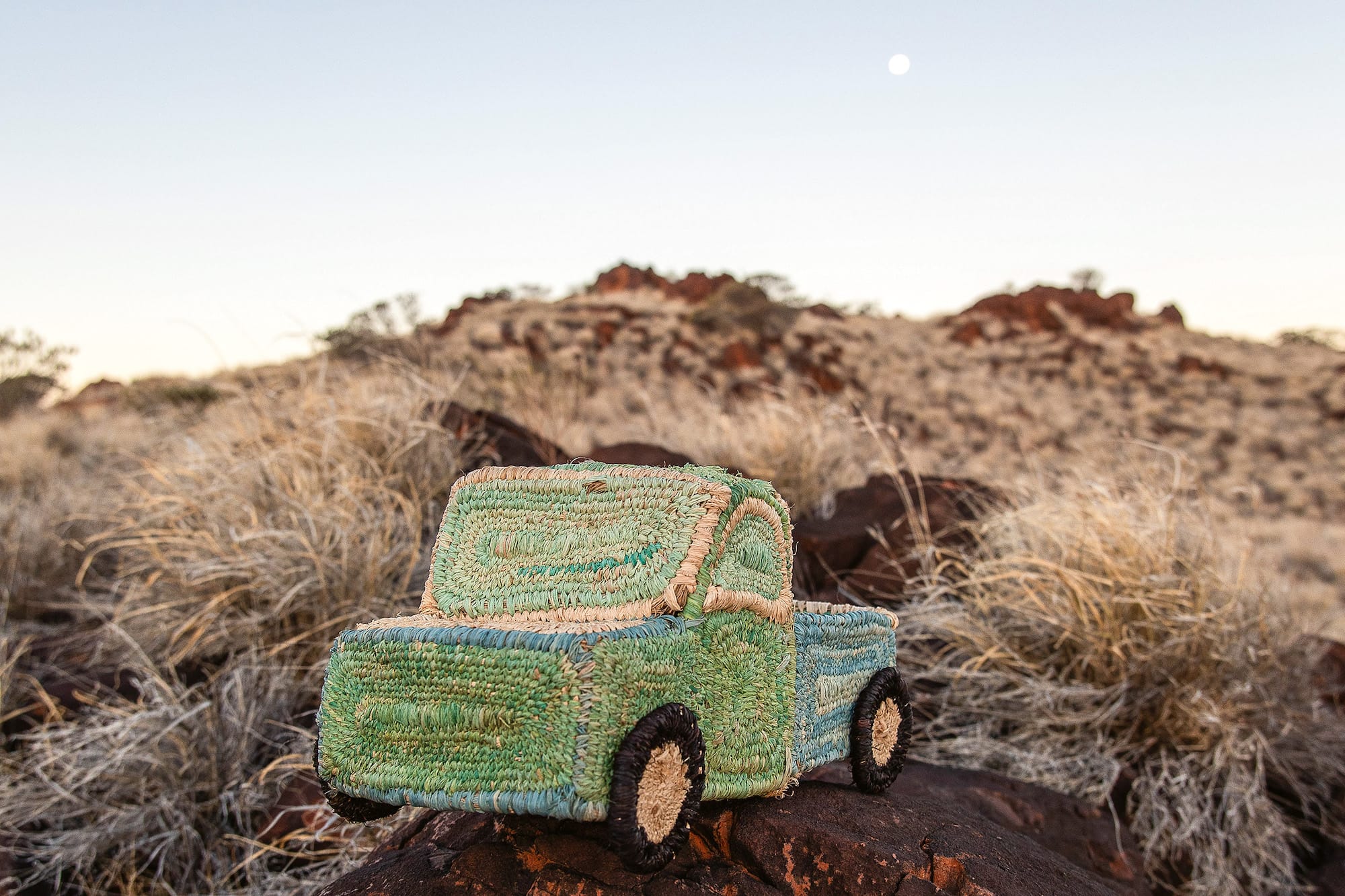
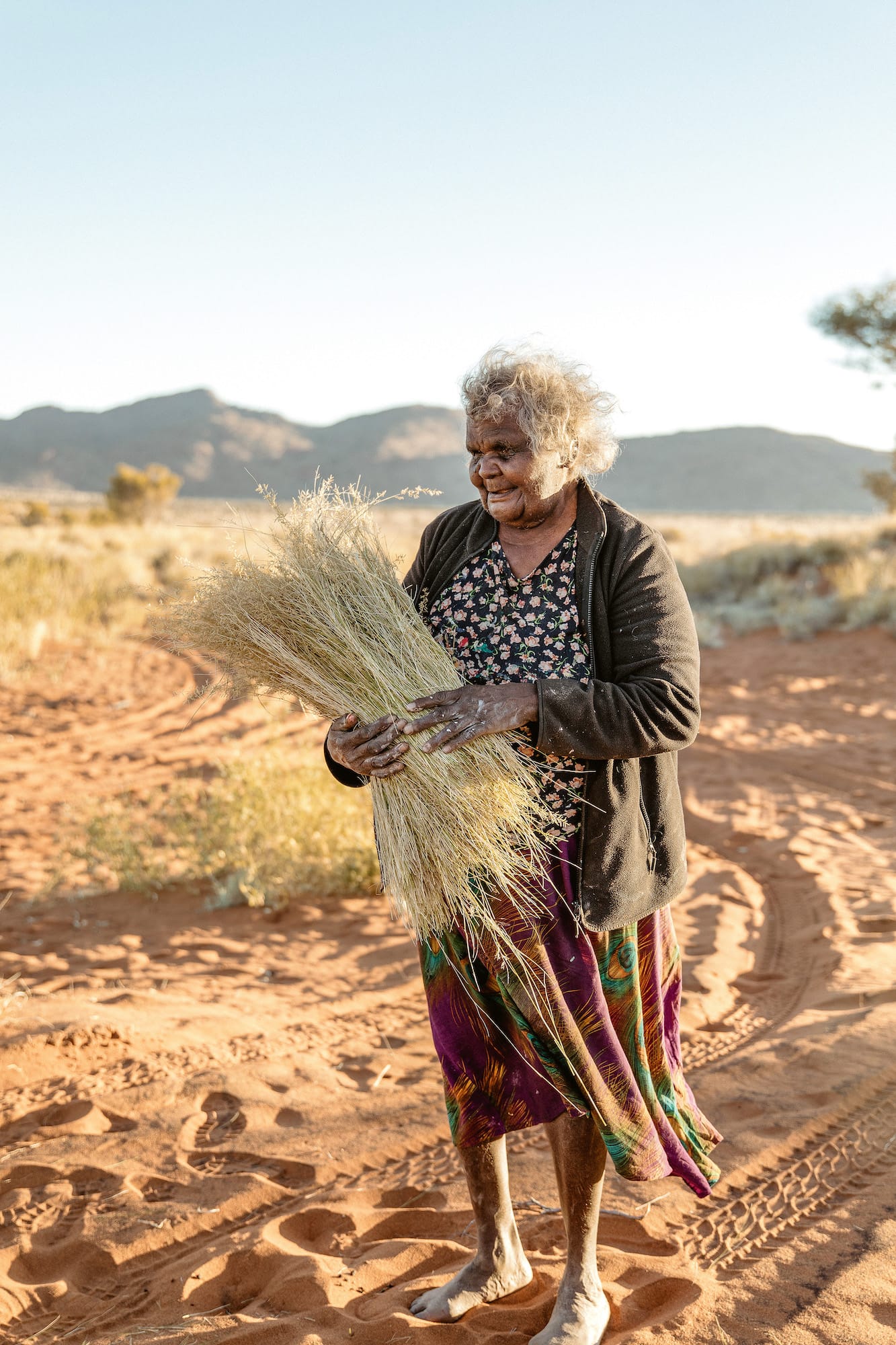
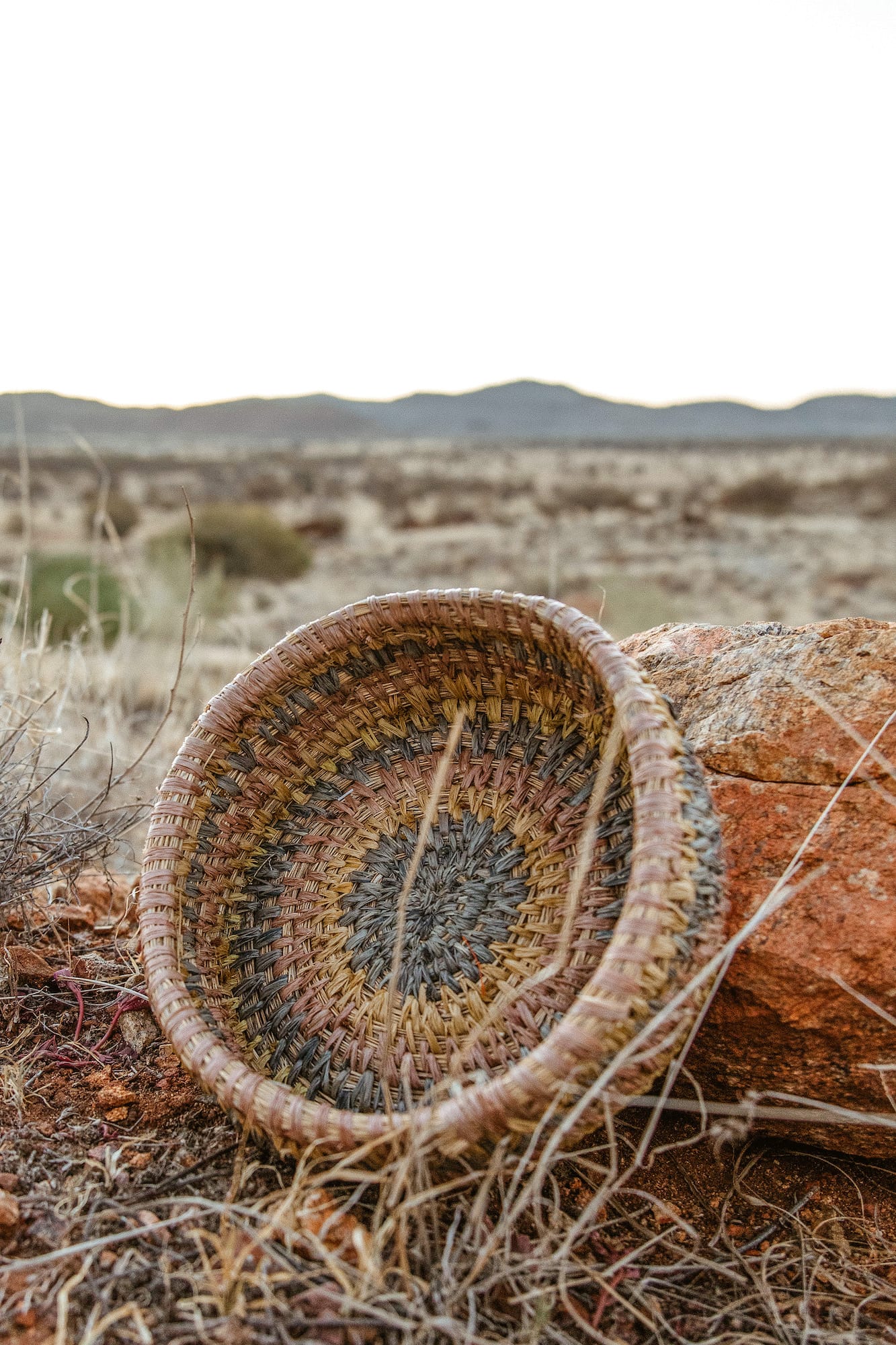
Imuna Kenta begins an artwork; Tjanpi ute sculpture by Donna Ferguson; Atipalku Intjalki with tjanpi (native grass), used for weaving; basket by Madeline Jackson. Photography by Brooke Bathern.
“My turn,” says Imuna Kenta, also in her late 70s and a key Tjanpi Desert Weavers figure. “Once upon a time we didn’t know about tjanpi weaving. But as soon as we found out about it and learned how to do it, there was no stopping us.”
Her hands fly like birds as she describes her work.
“We’d weave all day and then have a rest, have a sleep and then get up and start all over again. We all learned so fast, and learned how to make good strong stitches, with straight edges and made sturdy baskets and sculptures.
“During our learning phase we had to learn the hard way about the occupational hazards of stitching with wild grasses, because sometimes there would be prickles in them, or sharp ends.
“Also, the metal needles we use have to be handled carefully; when pushing the needle through, we always have to make sure we do not pierce our hands and fingers. We learned together and passed on our skills to each other, and the quality of our work just got better and better all the time.
“I made a camel myself just recently. Then I made a start on an emu, which worked out really well and I did finish it.” Later that day, we see Kenta’s emu for ourselves: a lively feathered chick with a tjanpi body and bright raffia eyes.
One afternoon we’re driven a short way to a rock-strewn plain edged by low hills, to take some photographs of the artists and their work. Tjanpi Desert Weavers’ marketing officer Genevieve Harold makes a whimsical tableau of tjanpi camels against tiny magenta wildflowers; Galah photographer Brooke Bathern – whose auntie, Sylvanna Kenny, is also a tjanpi weaver and often takes on translating and interpreting tasks – gently directs the older women into position with warmth, humour and respect.
The light turns golden and half-a-dozen curious donkeys emerge among trees in the middle distance. The donkeys have a special place in the hearts of the Tjanpi Desert Weavers as malpa wiru, valuable friends and helpers. In 2021, tjanpi donkey sculptures featured in a charming stop-motion animation, Tangki – Donkey, and subsequently a bilingual children’s picture book with Pitjantjatjara text by Tapaya and Kenta. One of the donkey characters is modelled after Wilma, a beloved donkey who lived in Pukatja/Ernabella and is buried in a well-tended grave outside the Ernabella Arts centre.
My head is spinning trying to track all the connections, and it drives home just how complex and intricately woven are the threads joining the artists, their work, the generations, their communities and their Lands.
Although the women clearly derive much pleasure from working with tjanpi, its benefits run far deeper. Collecting the tjanpi and making their art gives artists the chance to connect with each other and the land, gather bush tucker and share their stories – within their communities and ultimately with those of us living outside the NPY Lands.
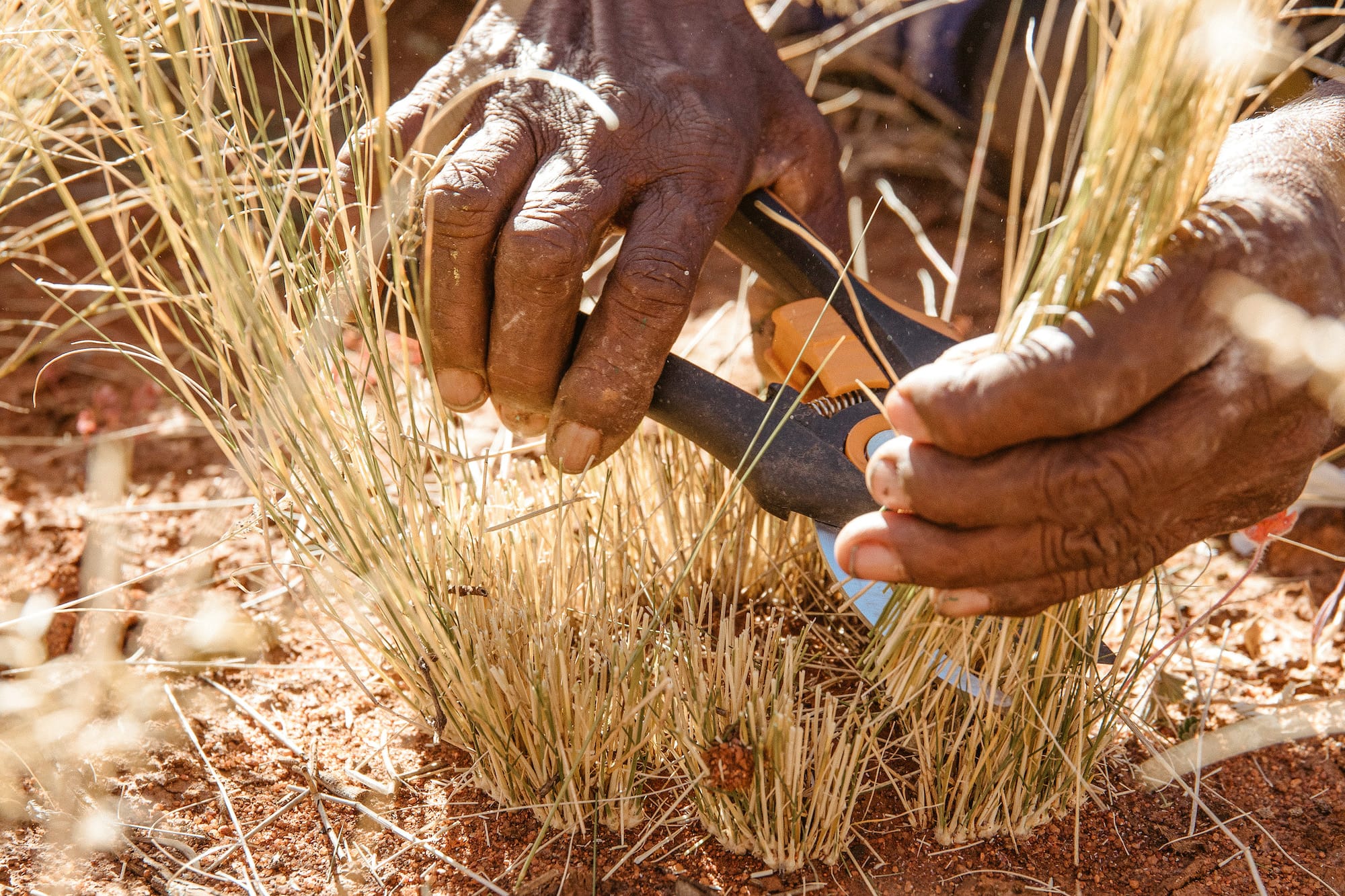
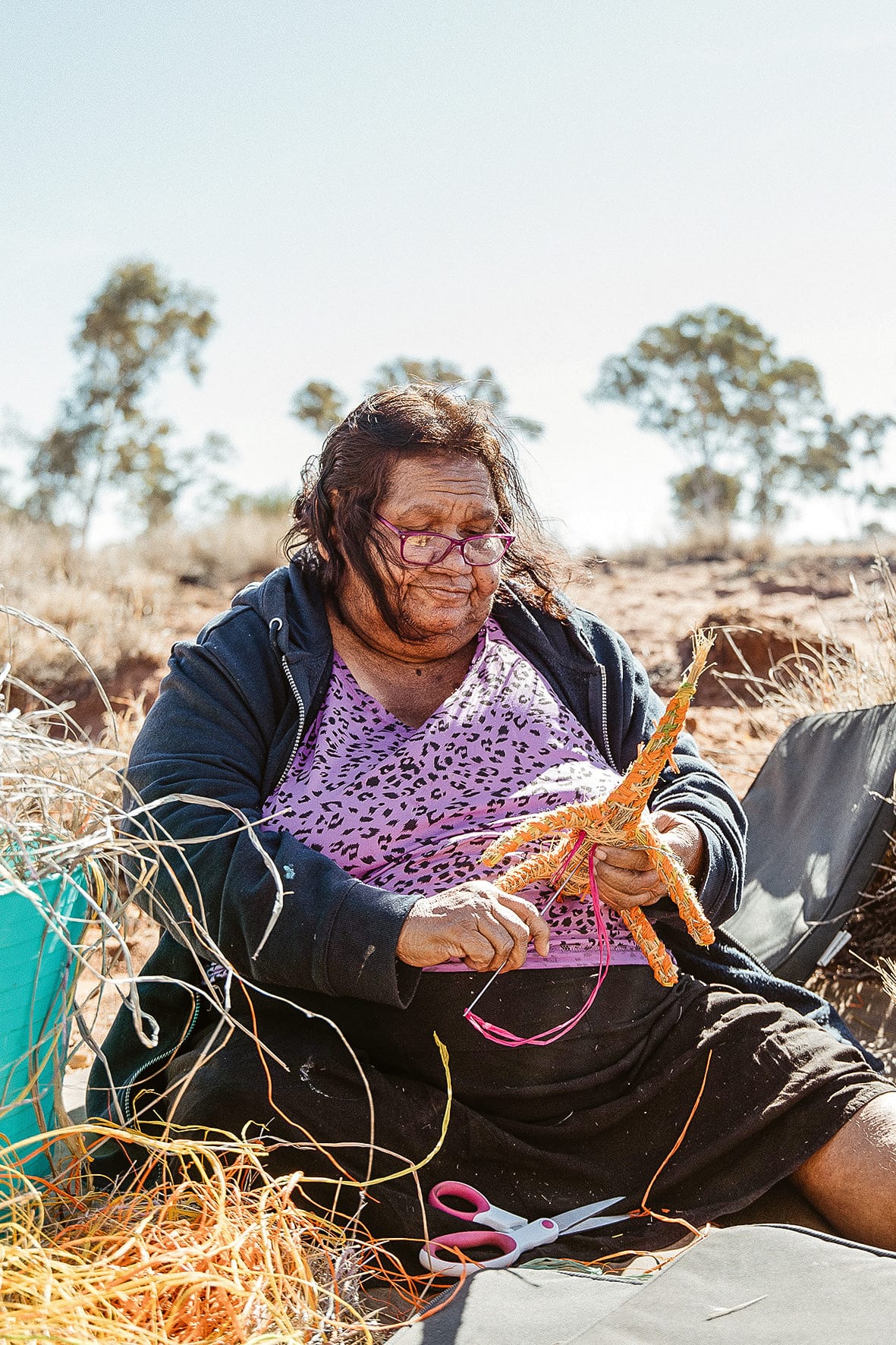
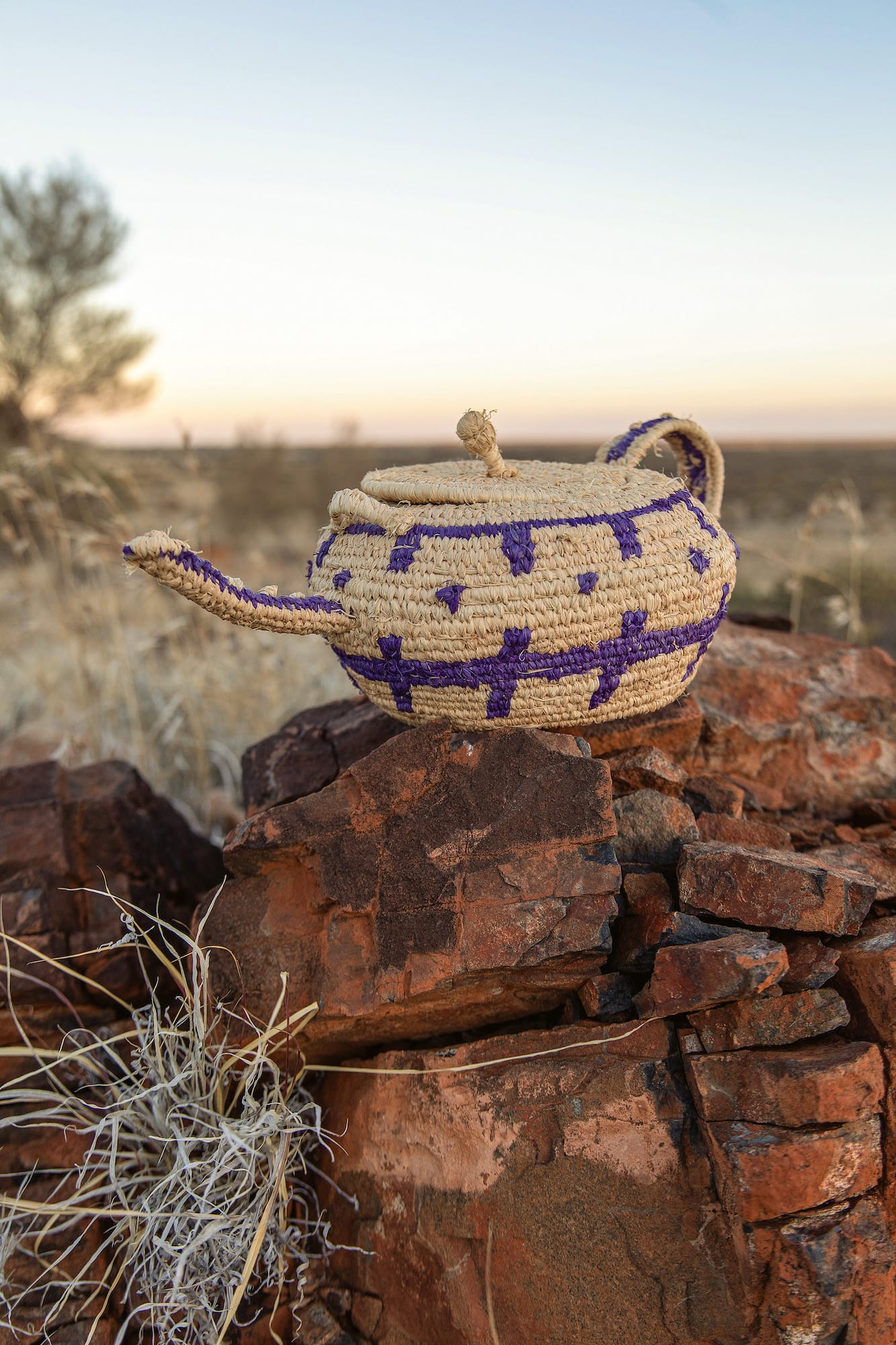
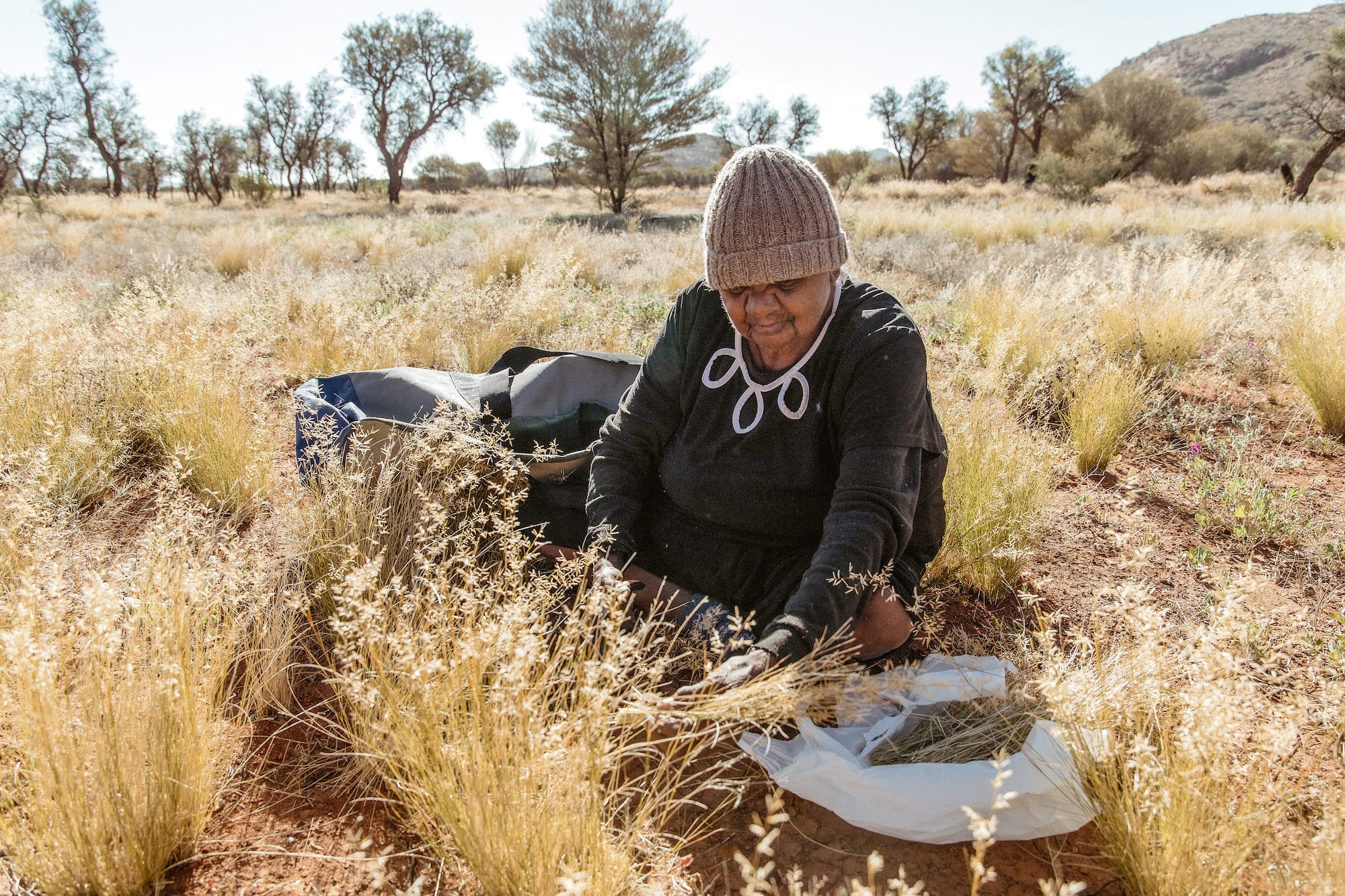
Imiyari Adamson collects tjanpi; Joyce Robin weaves a ngiyari (thorny devil) sculpture; a teapot made collaboratively by Tanisha Fox and her mother Yangi Yangi Fox; Imiyari Adamson at work. Photography by Brooke Bathern.
As part of the NPY Women’s Council, an Indigenous-directed and governed organisation delivering a range of health and other services, Tjanpi Desert Weavers enables women living in remote desert communities to earn an income from fibre art.
The enterprise is underpinned by a financial framework known to the artists and the employees as the Money Story. It’s simple, practical and transparent: in a three-way split, the artists are paid outright for their works, some goes to the retailer and the remainder is channelled back to support the artists – for example, funding the purchase of raffia, yarn, scissors and needles.
Artworks and other items, such as tea towels and learn-to-weave kits, are sold online and through outlets including the Tjanpi Desert Weavers retail space at the NPY Women’s Council offices in Mparntwe/Alice Springs.
For manager Michelle Young, who has overseen the evolution of Tjanpi Desert Weavers during the past 16 years, the next step will be a new retail gallery in the town’s Todd Mall. “What we have at the moment is a modest gallery, but I think we’ve moved past that,” she says. “There’s a real lack of Aboriginal-controlled organisations in the CBD. It’s an opportunity to increase knowledge about ethical art buying. There’s a real interest.”
Organisations such as Tjanpi Desert Weavers also support healthier ageing. Young sends me a link to recent findings of the National Ageing Research Institute. Working with Ikuntji Artists in the Northern Territory, Western Australia’s Mangkaja Arts Resource Agency and the Tjanpi Desert Weavers, the institute found that art centres keep elders strong and connected. Further, elders are the backbone of the art centres and vital to maintaining intergenerational ties.
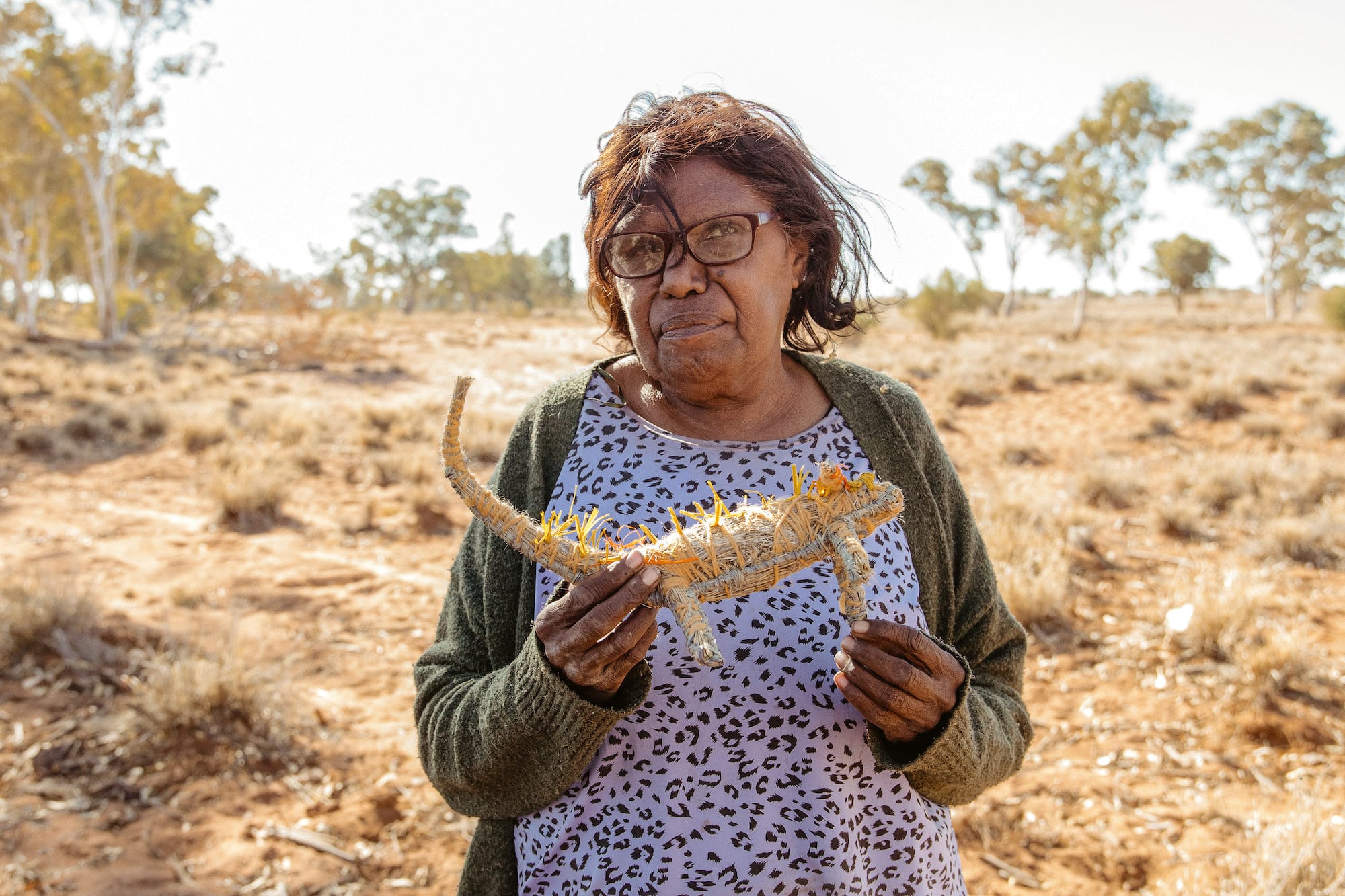
During my visit to the NPY Lands, I attend a weaving workshop in a dry creek bed in the community of Kaltjiti/Fregon, where I meet artist Rachael Stevens and watch her add the finishing touches to a tjanpi thorny devil – four strong legs, edged with bright raffia, and a spiky, tufted back.
“I was learning from my mother for a long time,” she tells me. “I make emus, make baskets, little ones and big ones, I make goannas. It makes me happy.”
And just as she learned from the older women, she’s passing on her skills and stories too. “Sometimes, my granddaughter makes little baskets. She’s happy, learning and watching. She’ll grow up making tjanpi.”
